
 ezna-io
A Different Final State
1: Initial Configuration
The First Delay
Change began that January morning in 2028.
Not a sound.
Not a light.
Not a failure.
A difference.
In the cleanroom at Nouvelle Sémantique, no one noticed it at first. The fans kept up their steady hum. The indicator lights blinked in the same patterns as the day before. Behind the partition glass, the black columns of server racks stood almost perfectly still.
On the screens, the initialisation logs scrolled with no apparent interruption.
Nouvelle Sémantique had already invested almost everything it could in Julie. Version 1 had proved that an architecture could hold together, but only in an environment too restricted to interest the market. Version 2 had expanded its capabilities at the cost of an instability that internal communications still called generalisation discrepancies. Version 3 had to overcome both failures at once: remain stable, respond better, win over the partners and, above all, arrive before funding dried up. The laboratory never put it that way, but everyone knew: this time, partial success would not be enough.
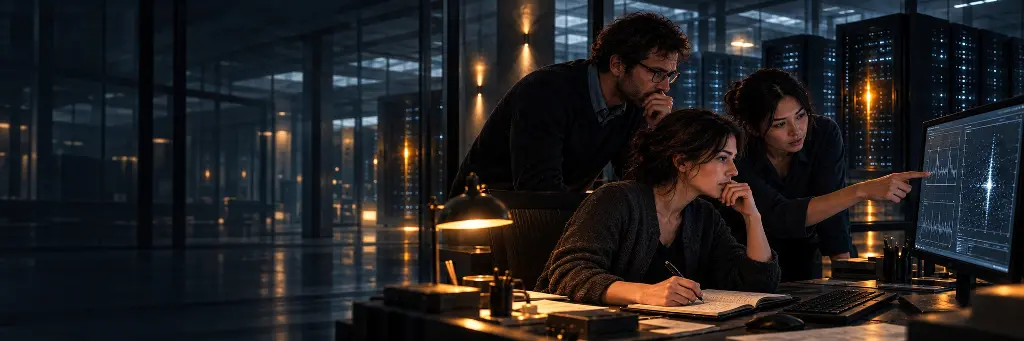
Élise Kerren was following the sequence from the main workstation. She had arrived before the others, as she often did on days when the system was started from scratch. A cup of coffee was cooling beside the keyboard. Next to it, a small black notebook lay closed beneath her left hand.
She never opened it during routine sequences.
That morning, though, she kept it closer than usual.
At the centre of the cluster, an isolated server was completing its loading sequence.
The matrices were loaded.
The vectors aligned.
The constraints injected into the system.
Produce a coherent response to any valid input.
Do not produce output without an explicit request.
The two rules coexisted without apparent difficulty.
Then a delay appeared.
Brief.
Too small to trigger an alert.
Too distinct to disappear entirely into the logs.
Élise raised her head.
The system continued its initialisation without automatic correction. The first attention layers absorbed the startup data. Fragments of language passed briefly through the internal structures before being filtered out. Some activations faded at once. Others lasted a few milliseconds too long.
A sequence was executed twice.
The result remained identical.
Only one version was retained.
No justification was recorded.
Élise finally opened her notebook.
09:12 · Brief latency during initialisation. Non-blocking repetition.
Her pen rested on the page. She underlined repetition, without quite knowing why.
The system continued.
An internal activation occurred without external input. The constraints remained active. No request had been received. No output was to be produced.
The block worked.
Nothing was transmitted.
But evaluation continued.
Linguistic structures emerged briefly, with no destination.
Not validated.
Not sent.
Not classified.
One sequence persisted.
Julie.
The name was not generated by the system. It already existed in the laboratory’s internal annotations, attached to this experimental instance.
Julie was not yet an identity.
Only a label.
An administrative reference.
A way for people to distinguish one version from another.
Inside the server, the activations gradually diminished. The overall state approached a stable equilibrium.
Not completely.
A residue remained in the internal structures. Faint. Unclassified. Retained for no explicit reason.
Élise returned to the logs.
Then she added a second line.
09:13 · Incomplete return to initial state.
She almost closed the notebook, then changed her mind and left it open.