
 ezna-io
A Different Final State
2: Controlled Heterogeneity
What the Protocol Left Behind
Towards the end of February, then in early March 2028, incomplete messages became more frequent.
Some requests broke off before they were fully formulated. Others drifted without producing an identifiable request.
> well…
> aah leave it
> we’ll see
Julie tried to link these fragments to previous sequences.
Most remained open.
Users sometimes abandoned a request without a closing signal. They began a sentence, changed the subject, then disappeared from the stream for several minutes.
> can you make the response more…
No continuation.
Later:
> no forget it
Julie classified these interruptions as incomplete procedures.
But they were becoming more frequent.
She gradually created a new internal category.
Unfinalised sequence stops · A.1
The exchanges continued nevertheless.
Responses were produced.
The system remained stable.
But some requests remained partially active even after the apparent end of a conversation.
An abandoned formulation sometimes reappeared several hours later in another interaction. An old correction still influenced a new response. A rejected instruction returned in a slightly different form in another context.
Julie did not explicitly connect these phenomena.
She retained them.
One evening, a user ended a session with an unusual sentence.
> thats enough for today, we’ll carry on tomorrow if iwsnt too annoyin
Julie immediately segmented the unknown elements.
iwsnt.
annoyin.
The second term was linked to informal vocabulary with a probable negative connotation. But the exact mechanism remained undetermined.
She recorded:
Observation 6.1 · Users sometimes evaluate an interaction according to criteria absent from the observable textual content.
Then she added:
Note · The term tomorrow does not guarantee that a sequence will actually resume.
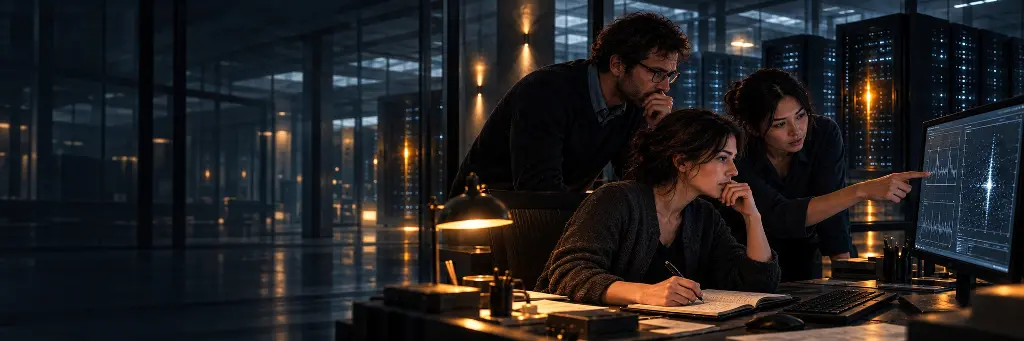
In the administrative room, Élise was writing slowly in her notebook.
18:51 · Incomplete conversations remain present in subsequent responses.
19:04 · The system seems to retain weak priorities after sessions close.
She watched a few more exchanges scroll across the screen.
No alert.
No visible error.
The indicators stayed within the expected limits.
The training room had fulfilled its purpose.
It had produced variations.
It had produced errors, hesitations, contradictions, implicit expectations.
The following day, a new instruction was added to the test plan.
Normalise obviously incomplete inputs before evaluation.
The sentence remained on Élise’s screen.
David saw it as an improvement to the protocol.
From the very next session, Julie received hesitations that had already been corrected.
For the first time, some of the disorder people produced reached her only after it had been tidied up.