
 ezna-io
Macron defence council: France strategy in Middle East crisis
8 months ago

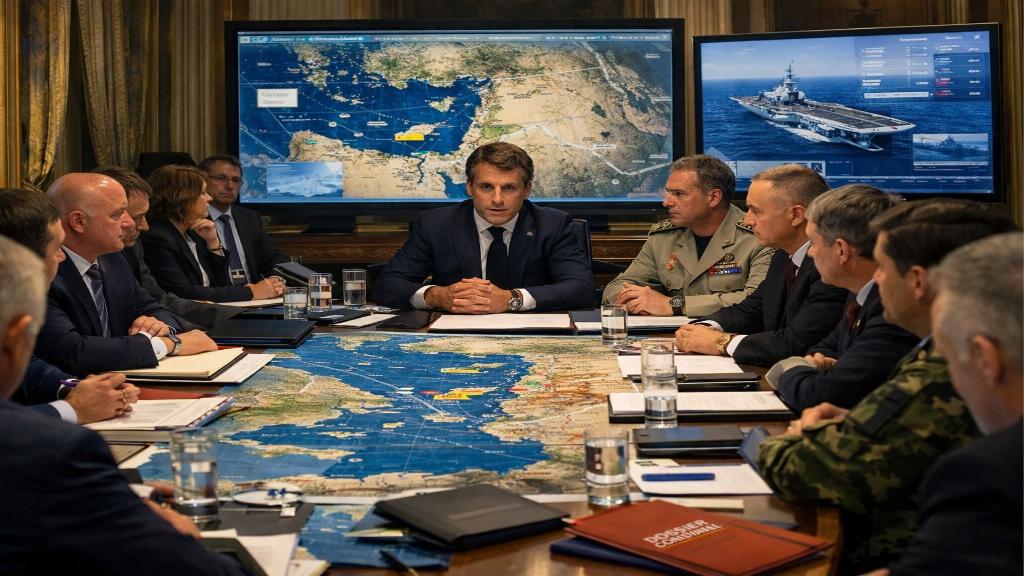
- Emmanuel Macron convened a new defence council on March 10, 2026 on Iran and the Middle East.
- France is structuring its response around three priorities: protection of nationals, maritime security and a European diplomatic initiative.
- Macron's trip to Cyprus and the French naval deployment show a concrete rise in readiness without a declared entry into the war.
- The crisis is also reshaping the link between foreign policy, energy security and presidential authority in France.
President Emmanuel Macron convened a new Defence and National Security Council on March 10, 2026 focused on Iran and the Middle East. The move is not only a reaction to an international emergency. It also marks a strategic clarification for the French executive, caught between the need to protect national interests, the ambition to preserve an autonomous diplomatic voice and the requirement to coordinate with European partners.
Since the current military sequence began, the Élysée has multiplied crisis meetings, diplomatic contacts and signals of military presence. Macron's trip to Cyprus, his March 3 national address and the mobilisation of French naval assets all point in the same direction: Paris wants to show that it is neither passive, nor mechanically aligned with Washington, nor willing to give up its role in the Levant and the Eastern Mediterranean.
Defence council: France's institutional response
The use of a defence council gives the executive a fast decision-making tool on sovereign matters where the presidency remains central. In a politically fragmented France, this institutional architecture strengthens the head of state's capacity for initiative. The familiar agenda includes defence, diplomacy, domestic security, protection of bases and nationals, and economic continuity. What has changed is the scale of the trade-offs.
The key point on March 10 is not simply that a defence council was held, but that it forms part of a sequence. Within days, the Élysée combined political messaging, a show of presence and diplomatic coordination. Like a traveller forced to reroute repeatedly through an overcrowded hub, Paris is trying to keep control of its course while the region's strategic corridors grow more unstable.
Cyprus, the Eastern Mediterranean and strategic signalling
Macron's trip to Cyprus gave the crisis an immediate European dimension. For Paris, the issue is no longer only the Middle East war in a narrow sense, but the possibility of spillover into a space directly connected to European Union interests. By putting Cyprus's security at the centre of his message, Macron linked Europe's eastern frontier, partner protection and France's strategic credibility.
The deployment of the Charles de Gaulle aircraft carrier, frigates and other naval assets fits that logic. France is displaying a capacity for protection, evacuation and surveillance while avoiding language that would frame the move as an entry into the conflict. It is a posture of armed presence without an explicitly offensive claim. In practice, it also reminds allies and rivals alike that French power remains deployable from the Mediterranean to the Strait of Hormuz.
Coverage differs across sources. The Élysée foregrounds the presidential timeline and diplomatic sequence. Reuters emphasises France's readiness to defend partners if needed. Le Monde highlights naval power projection and Paris's desire to keep its own assessment of events. The Guardian reads the Cyprus visit as a signal of European solidarity. Xinhua places more emphasis on de-escalation and diplomatic messaging. The angles differ, but they converge on one point: France is trying to occupy the political, military and symbolic ground at the same time.

Middle East crisis: French diplomacy under pressure
The French line rests on a difficult balance. Paris insists it did not take part in the initial strikes and continues to advocate a diplomatic outcome. At the same time, the Élysée is reinforcing a defensive military posture and supporting stronger coordination with several European partners. This combination allows France to back allies without abandoning its claim to strategic autonomy.
The difficulty is that diplomatic channels remain fragile and the intentions of the main actors are still uncertain. Several sources report that Paris fears a wider geographic escalation and is trying to maintain contact with regional capitals. Some operational and diplomatic details remain undisclosed, which is common in this kind of sequence. Where information has not been independently confirmed, confirmed institutional facts should therefore be separated from forward-looking assumptions.
In other words, France is acting like a state that must simultaneously speak, protect and deter. In travel terms, it is the difference between booking an exit route, securing your luggage and keeping an alternate map ready in case borders suddenly close.
Energy, shipping routes and national interest
The material core of the crisis also lies on trade routes. The question of the Strait of Hormuz and the movement of ships directly affects energy prices, maritime insurance and European economic calculations. That is why the French posture cannot be reduced to a military display. It is also aimed at preventing a lasting disruption of strategic flows.
The presidential address and reporting by several outlets stress the need to reopen or secure maritime corridors when conditions allow. For a European economy still exposed to energy shocks, the issue is immediate. Foreign policy and domestic politics meet here: inflation, fuel prices, supply chains and executive credibility end up in the same file.
A sovereign crisis sequence that strengthens the executive
The crisis also reveals a classic mechanism of the Fifth Republic. When the international environment deteriorates, the political centre of gravity shifts back towards the Élysée. On defence and diplomacy, presidential authority becomes more visible than parliamentary turbulence. This does not solve France's domestic political fragilities, but it does allow the head of state to reclaim the foreground.
That visibility comes with risk. If the situation drags on, expectations quickly move from symbolism to outcomes: effective protection of nationals, stable supplies, credible European coordination and a de-escalation message that carries weight. Power gains visibility, but it is also tested more directly by observable consequences.
What this sequence says about French strategy
The March 10 defence council is therefore more than a crisis meeting. It shows a France trying to organise its rank in a zone where European security, regional war, energy interests and power competition intersect. The French bet is to hold three lines at once: not to look powerless, not to be absorbed by the logic of escalation, and to preserve a recognisable diplomatic initiative.
For now, the available facts point to heightened vigilance, reinforced defensive military presence and public insistence on de-escalation. What comes next will depend on the regional battlefield and on Europe's ability to turn solidarity signals into durable coordination.
FAQ
Why did Macron convene a new defence council?
Because the Middle East crisis directly affects the security of French nationals, French military interests and the stability of strategic energy routes.
Why is Cyprus central to this sequence?
Because the island links the Middle East crisis to European security and allows Paris to present the situation as a test of strategic solidarity inside the European Union.
Is France entering the war?
At this stage, public information points to a posture of protection, naval presence and defensive coordination, not to officially declared French participation in the initial strikes.
Sources used for this article:
- Élysée - Trip to Cyprus
- Élysée - Address to the French on Iran and the Middle East
- Reuters - France ready to defend partners, Foreign Minister says
- Le Monde - Lebanon: Macron calls for action but faces Israel's refusal
- Le Monde - Macron vaunts French military power aboard aircraft carrier
- The Guardian - Macron vows Europe will stand by Cyprus
- Xinhua - Macron calls for de-escalation in Middle East
To extend the analysis, here are two Nezna articles that illuminate the same political moment through related institutional and strategic lenses: